Even as you read this article, computer chip manufacturers are furiously racing to make the next microprocessor that will topple speed records. Sooner or later, though, this competition is bound to hit a wall.
Microprocessors made of silicon will eventually reach their limits of speed and miniaturization. Chip makers need a new material to produce faster computing speeds.
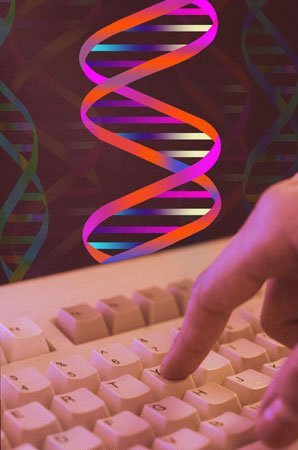
You won't believe where scientists have found the new material they need to build the next generation of microprocessors. Millions of natural supercomputers exist inside living organisms, including your body. DNA (deoxyribonucleic acid) molecules, the material our genes are made of, have the potential to perform calculations many times faster than the world's most powerful human-built computers. DNA might one day be integrated into a computer chip to create a so-called biochip that will push computers even faster. DNA molecules have already been harnessed to perform complex mathematical problems.
While still in their infancy, DNA computers will be capable of storing billions of times more data than your personal computer. In this article, you'll learn how scientists are using genetic material to create nano-computers that might take the place of silicon-based computers in the next decade.
Silicon vs. DNA Microprocessors
Silicon microprocessors have been the heart of the computing world for more than 40 years. In that time, manufacturers have crammed more and more electronic devices onto their microprocessors. In accordance with Moore's Law, the number of electronic devices put on a microprocessor has doubled every 18 months. Moore's Law is named after Intel founder Gordon Moore, who predicted in 1965 that microprocessors would double in complexity every two years. Many have predicted that Moore's Law will soon reach its end, because of the physical speed and miniaturization limitations of silicon microprocessors.
DNA computers have the potential to take computing to new levels, picking up where Moore's Law leaves off. There are several advantages to using DNA instead of silicon: As long as there are cellular organisms, there will always be a supply of DNA.
DNA computers have the potential to take computing to new levels, picking up where Moore's Law leaves off. There are several advantages to using DNA instead of silicon: As long as there are cellular organisms, there will always be a supply of DNA.
Unlike the toxic materials used to make traditional microprocessors, DNA biochips can be made cleanly. DNA computers are many times smaller than today's computers.
DNA's key advantage is that it will make computers smaller than any computer that has come before them, while at the same time holding more data. One pound of DNA has the capacity to store more information than all the electronic computers ever built; and the computing power of a teardrop-sized DNA computer, using the DNA logic gates, will be more powerful than the world's most powerful supercomputer. More than 10 trillion DNA molecules can fit into an area no larger than 1 cubic centimeter (0.06 cubic inches). With this small amount of DNA, a computer would be able to hold 10 terabytes of data, and perform 10 trillion calculations at a time. By adding more DNA, more calculations could be performed.
Unlike conventional computers, DNA computers perform calculations parallel to other calculations. Conventional computers operate linearly, taking on tasks one at a time. It is parallel computing that allows DNA to solve complex mathematical problems in hours, whereas it might take electrical computers hundreds of years to complete them.
Unlike conventional computers, DNA computers perform calculations parallel to other calculations. Conventional computers operate linearly, taking on tasks one at a time. It is parallel computing that allows DNA to solve complex mathematical problems in hours, whereas it might take electrical computers hundreds of years to complete them.
The first DNA computers are unlikely to feature word processing, e-mailing and solitaire programs. Instead, their powerful computing power will be used by national governments for cracking secret codes, or by airlines . wanting to map more efficient routes. Studying DNA computers may also lead us to a better understanding of a more complex computer -- the human brain.
Sources:
http://www.tech-faq.com/
http://computer.howstuffworks.com
http://www.tech-faq.com/
http://computer.howstuffworks.com