Saturday, December 31, 2011

Happy New Year 2012


Happy New Year Everybody

 I hope this year brings peace and happiness to everyone


Here are the Top 10 news of 2011.


1. Year of the Hacktivist 


2011 is undeniably the year of the hacktivist. Till 2010, hackers limited their attention and effort to hack for personal gain but year 2011 changed everthing.

As the hackers collectives such as LulzSec and Anonymous emerged, the motive behind hacking became more of a social crusade and less of personal gain. And in strokes after strokes, Web sites of major companies such as Sony Pictures, News Corporation and Petrobas, and government agencies such as FBI and CIA and even the U.S. Senate, which were once considered off-limits to hackers, fell.

The gaming industry was also not spared. PlayStation Network, Bethesda Game Studios and EVE Online were hacked impudently and taken down.And though, LulzSec quietened down in June/July (and probably disbanded), Anonymous refused to play dead and carried on to take on the might of nations such as Syria, Malaysia, Spain, Tunisia, Turkey, Brazil and Australia.


2. Social Media Stirs a Revolution


The power of social media to organize and influence the history was revealed to the fullest extent in year 2011. Sites such as Facebook and Twitter were no longer being used to just put up updates about one's life - they started to be used as tools for social change and influence the politics and the law of many nations. During 2011, the social media came to be used to mobilize grass root efforts all over the world, especially in Middle East and Africa such as Tunisia, Egypt, Libya and Syria to protest the status quo.


3. Steve Job's Death


Steve Jobs, a creative genius and a visionary who had established the most valuable company in the world, Apple, passed away at the age of 56, on Oct. 5. 

People around the world paid rich tributes to him, including Bill Gates, Mark Zuckerburg, Barack Obama and other celebrities and admirers. It was not surprising, as Jobs had radically changed the way people use technology in their daily lives.


4. Siri


When iPhone 4S was launched, critics said it had nothing spectacular to offer and Apple fans would be disappointed. However, Apple proved the critics wrong as iPhone 4S turned out to be the best selling iPhone ever - it even smashed previous debut weekend sales record. This was largely in part because of Siri and industry analysts later noted that Siri has become the most popular feature of the Apple iPhone 4S.


5. Ice Cream Sandwich


Ice Cream Sandwich, Google's newest operating system (Android 4.0) for phones, tablets, and more, was officially launched at the Galaxy Nexus and Ice Cream Sandwich release event on Oct. 19 2011.

Android 4.0 boasts of exciting features, including easy multitasking, customizable home screens, rich notifications, resizable widgets, and deep interactivity. Moreover, Ice Cream Sandwich also adds powerful new ways of communicating and sharing.


6. Year of the Apple: iOS 5, Mac OS X Lion and iCloud Launched

 
After a long wait, Apple's iOS 5, Mac OS X Lion and iCloud were unveiled at WWDC (worldwide Developers Conference) 2011 on June 6.

iOS 5, which is regarded as Apple's "major" and “incredible” release for developers and customers alike, has over 200 new features, including Improved Notifications System, News Stand, Improved Mobile Safari, Reminders, Camera, Mail, PC Free Function, iMessage and more.

Mac OS X Lion, Apple's desktop and server operating system for Macintosh computers, was a huge hit, notching a sales record of 1 million units on the first day of its release. It was the first time Apple sold Mac OS as a downloadable software. 

iCloud, Apple's cloud storage and cloud computing service which replaces MobileMe service, can help users to store data on remote computer servers for download to multiple devices including iOS-based devices, and personal computers running Mac OS X or Microsoft Windows. 


7. Nest Energy Efficient Thermostat


Nest Energy Efficient Thermostat, a sensing, automatic energy-saving thermostat developed by Tony Fadell, the creator of iPod, made waves in 2011. 

The thermostat is no ordinary, traditional mercury-filled home thermostat we're all used to. Unlike other thermostats, the user-friendly Nest will "learn" and keep track of when you turn its temperature up and down. It remembers those adjustments in line with the particular times of day and night when you change them. And, after about a week, Nest will start regulating the temperature on its own for you.


8. Acquisitions - Hits and Misses

This year, the acquisitions among tech companies made headlines for one reason or the other. Microsoft bought Skype in May for $8.5 billion, which is the software giant's largest acquisition ever. In August, the Internet search engine giant Google acquired Motorola Mobility, the maker of smartphones and set-top boxes, for $40.00 per share in cash, or a total of about $12.5 billion.


9. Amazon Kindle Fire

 
In 2011, for the first time, Apple's evergreen iPad met its match (or just about) in the form of Kindle Fire from e-retailer Amazon. When Amazon made headlines by launching a price-breaking tablet ($199) and though the company said Kindle Fire is not out there to challenge iPad, Apple's popular tablet faced real threat for the first time as Kindle Fire turned out to be Amazon's best selling product ever. 

For the first time, people woke up to the potential for e-reading and consumption of audio and video contents and the success of the 7-inch tablet has now emboldened other tablet makers to announce plans of launch of affordable tablets in 2012.


10. Apple Versus Samsung Courtroom Battles

The courtroom battles between Apple and Samsung around the world never seems to end. Early in April, Apple sued the Korean electronics giant in the U.S., claiming Samsung infringed its patent for list-scrolling software and three smartphone and tablet design patents. Subsequently, the patent war between the two companies expanded to Europe and Australia.


sources: http://www.ibtimes.com
               http://www.google.com

Thursday, November 3, 2011

How To Enable Facebook Timeline


Timeline will go live on Thursday, November 10, 2011. (as it is announced by Facebook)

But How if we want to try it right now :)

Thanks to GREG KUMPARAK for his article

Here is how:

Sunday, September 25, 2011

Mark Zuckerberg at F8 Developer Conference

Mark Zuckerberg Makes Announcement At Facebook Headquarters

Facebook CEO Mark Zuckerberg delivered keynote address today, known as the F8 Developers Conference. With 2,000 people in the auditorium to watch live and hundreds of thousands watching streaming video of the event online, here's an update on what we've learned.

So here's what we've learned so far:

Timeline - Billed as the "story of your life," Timeline will give you "new ways to express who you are," according to Zuckerberg. It looks nothing like your regular profile that you know and love now. Rather, it's laid out magazine style, left to right, and you can drag things into it to fill out your Timeline. For example, Zuckerberg took a picture of himself from 1990 and dropped it.

Real Time Serendipity - Zuckerberg talked a lot about music and how he wants to better integrate tunes into Facebook. He likes Jay-Z and Greenday if you were wondering. With the new status bar, you'll be able to see what music your friends are listening to, click on their name and the track, and join in on the fun, or "listen along."


Here you can watch the video of the conference

http://f8.facebook.com/


Monday, August 8, 2011

Google+


What is Google+ (Google Plus) and do I need it?


Google+ vs. Facebook: Mark Zuckerberg's Reaction


-------------------------------------------------


We are all waiting for the Full version of Google+


With my regards


Abdullah

Sunday, August 7, 2011

Turkey Plans Internet Filtering (coming soon 22 August)


Under a decision on “Rules and Procedures of the Safety of Internet Use,” approved by the Information Technologies Board or [BTK] in February, Internet users in Turkey will have to choose one of four Internet packages: family, children, domestic or standard. The list of websites filtered by each package will be decided by the BTK but will not be made public.

The change will be implemented starting Aug. 22

Users will have to choose one of four filters. One is called the family filter and another is for children. The domestic filter blocks all foreign sites. And the standard package will be the default. Yaman Akdeniz, a law professor at Bilgi University, worries that Turkish authorities will use these filters to step up control of the Internet.

“They are not telling us whether there will be monitoring of everyone’s habits and usage, since everyone will have a user name and password under this system,” said Azdeniz.

The head of the telecommunications regulatory agency, Tayfun Acarer appeared on television and denied that any filters would be mandatory. He said that the measures are meant only to enforce Turkish law.

“Turkey is more transparent than many other countries regarding this issue,” Acarer said. “I want to emphasize this. When you go to a banned site in a European country, you see only a flag or a stop sign. But if a web site is blocked in Turkey, it is always clearly stated when, why and by which institution the page was banned.


As the board’s decision does not have a legal basis, its limitations and authorities are not clear either, according to Kerem Altınparmak, an expert in human rights law who spoke Tuesday in an interview on NTVMSNBC. “According to what extent [and what measures] will such a decision be applied? There is no [provision] on this [on the decision].

“If we assume that a family consists of five members, of ages between 8 and 60 and it has only one computer: which package shall it choose?” Altınparmak said, adding that adults risked to be treated like children regarding access to various Internet websites.

I like to remind you that thousands of people in more than 30 cities around Turkey took to the streets on May to protest the new system of filtering the Internet that opponents consider censorship. 
sources:
http://www.nytimes.com
http://www.theworld.org

Saturday, August 6, 2011

IBM scientists create a new memory technology that’s 100x faster than flash

IBM developed a new type of computer chip memory that can store multiple data bits per cell, a discovery that could lead to better performance for enterprise data storage and cheaper memory chips for consumer electronics like mobile phones.


Traditionally, data is stored as an electrical charge. But this new memory chip technology called phase-change memory stores data by changing the state of a material from amorphous to crystalline. PCM stores data when there’s a resistance change in the material. It uses less power than flash memory and can write data 100 times faster than any flash memory that is available today.


Currently only single-level cells PCM are on the market and are found in products like Samsung’s GT-E2550 GSM mobile phone. The multi-level cell technology could lead to better storage density, keep data forever and reduce manufacturing costs.


“As organizations and consumers increasingly embrace cloud-computing models and services, whereby most of the data is stored and processed in the cloud, ever more powerful and efficient, yet affordable storage technologies are needed,” Haris Pozidis, manager of Memory and Probe Technologies at IBM Research said in a statement.


The chip is 90 nanometers in width. It can store data when there’s no power supply and won’t corrupt the data. IBM researchers have been working on PCM for a while. In 2005, IBM partnered with Infineon and Macronix to develop PCM because the researchers saw a potential for PCM to succeed flash memory chips, which are in consumer electronics such as digital cameras.


However, IBM won’t produce the new memory chips, but plans to license the technology out to others.


source: http://www.smartplanet.com

Sunday, July 24, 2011

Google SSL Search

Image and video hosting by TinyPic


SSL Search


With Google search over SSL, you can have an end-to-end encrypted search solution between your computer and Google. This secured channel helps protect your search terms and your search results pages from being intercepted by a third party. This provides you with a more secure and private search experience.
To use search over SSL, visit https://encrypted.google.com each time you perform a search. Note that only Google Web Search and Google Images are available over SSL, so other products like Google News and Google Maps are not currently available over SSL. When you're searching over SSL, these properties may not appear in the left panel.

What is SSL?


SSL (Secure Sockets Layer) is a protocol that helps provide secure Internet communications for services like web browsing, e-mail, instant messaging, and other data transfers. When you search over SSL, your search queries and search traffic are encrypted so they can't be read by any intermediary party such as employers and internet service providers (ISPs).


Read More..

Source: http://www.google.com

Thursday, April 21, 2011

What is CAPTCHA?


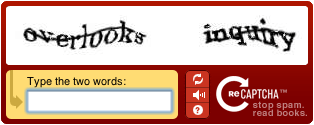
    A CAPTCHA is a program that protects websites against bots by generating and grading tests that humans can pass but current computer programs cannot. For example, humans can read distorted text as the one shown below, but current computer programs can't:


File:Modern-captcha.jpg


    The term CAPTCHA (for Completely Automated Public Turing Test To Tell Computers and Humans Apart) was coined in 2000 by Luis von Ahn, Manuel Blum, Nicholas Hopper and John Langford of Carnegie Mellon University.

CAPTCHA example

    CAPTCHAs are used in attempts to prevent automated software from performing actions which degrade the quality of service of a given system, whether due to abuse or resource expenditure. CAPTCHAs can be deployed to protect systems vulnerable to e-mail spam, such as the webmail services of Gmail, Hotmail, and Yahoo! Mail.

    CAPTCHAs are also used to minimize automated posting to blogs, forums and wikis, whether as a result of commercial promotion, or harassment and vandalism. CAPTCHAs also serve an important function in rate limiting. Automated usage of a service might be desirable until such usage is done to excess and to the detriment of human users. In such cases, administrators can use CAPTCHA to enforce automated usage policies based on given thresholds. The article rating systems used by many news web sites are another example of an online facility vulnerable to manipulation by automated software. As of 2010, most CAPTCHAs display distorted text that is difficult to read by character recognition software.


Because CAPTCHAs rely on visual perception, users unable to view a CAPTCHA due to a disability will be unable to perform the task protected by a CAPTCHA. Therefore, sites implementing CAPTCHAs may provide an audio version of the CAPTCHA in addition to the visual method. The official CAPTCHA site recommends providing an audio CAPTCHA for accessibility reasons, but it is not usable for deafblind people or for users of text web browsers.


    Even audio and visual CAPTCHAs will require manual intervention for some users, such as those who have disabilities. There have been various attempts at creating more accessible CAPTCHAs, including the use of JavaScript, mathematical questions ("how much is 1+1") and common sense questions ("what colour is the sky on a clear day"). However, these types of CAPTCHAs do not meet the criteria for a successful CAPTCHA. They are not automatically generated and they do not present a new problem or test for each attack.

    Some researchers promote image recognition CAPTCHAs as a possible alternative for text-based CAPTCHAs. Computer-based recognition algorithms require the extraction of color, texture, shape, or special point features, which cannot be correctly extracted after the designed distortions. However, human can still recognize the original concept depicted in the images even with these distortions.
File:Airplane CAPTCHA JPG.jpg

    A recent example of image recognition CAPTCHA is to present the website visitor with a grid of random pictures and instruct the visitor to click on specific pictures to verify that they are not a bot (such as “Click on the pictures of the airplane, the boat and the clock”). Image recognition CAPTCHAs face many potential problems which have not been fully studied.

Captcha


Sources:


Thursday, April 14, 2011

Nokia Phone Concepts


Nokia Morph


Unveiled in 2008, the Morph was the product of a joint study into the future of mobile phones by Nokia and the University of Cambridge’s Nanoscience Centre.

It tops our list because some of its super cool ideas are just mind-blowing! Its flexibility for starters; it could be worn around the wrist or held up to the face. The Morph would also contain self-cleaning surfaces that absorb solar energy so it can recharge the phone’s battery. Last but by no means least, it looks like something straight out of a futuristic Sci-Fi film!!!


Nokia 888

Dubbed the Nokia 888, this concept phone is ultra-lightweight, wafer thin and incredibly flexible. It is powered by liquid battery and has a touch screen display. What more could you want?


Nokia E-Cu

Scaling the dizzy heights at number 2, is a concept phone that uses your body heat to charge itself! We’ve all been there, our mobile phone is about to die and we can’t get to a charger in time. Well the Nokia E-Cu would solve this problem. Built with a thermo generator, it could convert heat into energy. The idea is that by putting the phone in your pocket, you will get a charge, so by our logic, putting it next to a radiator would give you a turbo-charge it!


Nokia Kinetic Concept


Designed by Jeremy Innes-Hopkins, the Nokia Kinetic concept phone turns digital information into kinetic energy by way of the electromagnet in its base. In normal speak this basically means that when a call is received, the weight in the base can be shifted and the phone rises. Don’t want to take the call? Just tap it back down. How cool is that?!


 Nokia E97 Envelop


When I look at the E97 Envelop concept phone from Nokia, I got convinced that a man’s imagination has no boundaries.
The Nokia E97 Envelop is definitely designed to impress. How nice it is to see a new Nokia concept phone, even if the mobile phone is not materialized by the company itself, but thanks to all the talented people it become possible to imagine what a Nokia phone in the future might look like.

With dark and smoothed edges, the Nokia E97 has a unique liquid crystal screen that comes out of the keyboard and can be removed from the cell, you simply pull the screen like a paper envelope, and the unplugged display can be used as a storage device, a flash drive for example. The smartphone features a AZERTY keyboard. 
Plus, the phone works with two SIM cards (sim) simultaneously.The concept of this mobile with a pull-out LED display that comes out of a keyboard, and that can be removed from the phone itself was developed by a young student named Fabien Fabien Nauroy (France) and he called this phone E97 Envelop.


Nokia UNIX


Talk about a concept cellphone which brings things to a whole new level with the Nokia Unik. Designed by French designer Clement Logereau, the Unik comprises of 152 small squares, where the handset is able to transform itself by virtue of adding in new squares that are different in material and color. These squares can be added after a purchase from Nokia stores, leacing you with a choice of metal, transparent and rubber squares. Something tells us that the Nokia Unik will remain just that – a unique concept.


Sources:

Sunday, April 10, 2011

How Acer's Dual Screen Laptop Works

The $1,300 Acer Iconia laptop is certainly unique. The machine features two 14-inch touchscreens instead of the tried and true screen-and-keyboard combination, while retaining the same form factor as a standard laptop. 


techland.time.com

Wednesday, March 2, 2011

Breaking News: Blogger Banned in Turkey


    According to FalconHive "Turkish Blogger users reported that Digiturk caused ban of Blogger again. As we know Digiturk, the leading satellite TV provider, sued some blogspot adressses for streaming live football matches online and Turkish courts decided to block the entire blogspot blogs including Blogger.com three years ago, in 2008. Recently some webmasters have used Blogger to stream live football matches again and as a result Digiturk has caused the ban of Blogger in Turkey.

   After many Blogger users used social media to make Digiturk and Google hear their voice, Digiturk published a written press release which stated that Google Turkey was irresponsive to their requests of banning the given blogspot links which were about twenty. Turkish Blogger users are determined to unblock the access to Blogspot links and they keep protesting both Google and Digiturk using#blogumadokunma hash-tag.
    Since it is not possible to stream something live through Blogger, the decision taken by Turkish court can be considered as wrong decision. Actually webmasters get an embed code from some live streaming websites and use the code in their blogs to drive traffic and monetize their short-term blogs easily. So both Digiturk and the Turkish courts should deal with those live streaming sites instead of free blog providers. Feel free to tweet this post to support Turkish Bloggers’ effort." 
sources: