Wednesday, May 15, 2013

5 Tips For Living In The Moment And Achieving Your Dreams

Let me share with you a different thing rather than technology related issues.
This is written by DAVID ARENSON

I frequently get asked, “Why is my life not working. Why am I not happy?” 
In an age of abundance, why are so many people struggling to find happiness and balance? The answers are manifold, and I will only explore a few concepts for the sake of brevity.

Five ways to nurture your soul:

1. Instill stillness.

Happiness is our birthright. It comes to us as naturally as breath. It is only thoughts that create mental clutter, which interrupt the natural flow of life. Thoughts may be calmed via time in nature, breath, exercise, yoga, meditation, relaxing music. Calm thoughts allow us to be present, conscious of our surroundings, conscious of our body-mind-spirit… awake. ?

2. Connect and live from the heart.

Are you living from your heart? A predominantly head-centered society has not led to a happy society. The heart is the true seat of wisdom, the true source of innate intelligence. Nothing is more powerful than listening to your heart. ?

3. Follow your passion.

Are you following your passion? The heart yearns to be free of disruptive chaotic thought, so it can communicate to you with clarity and power. When you open yourself up to listening to your heart, it will guide you to follow your passion. Your heart is the vehicle for your passion to be made manifest in the world. A life of passion is a life of happiness.?

4. Clean out your beliefs with a mental detox.

What are your beliefs about life? Are most of your beliefs based on society? Government? Parents? Religions? Media? To change your life, start with cleaning out your beliefs, gaining a fresh perspective, and starting anew with a clean slate.?

5. Cultivate your thoughts.

What do you tell yourself? Does your inner voice say positive things? You are the story that you tell about yourself. So if you want something different, you have to start telling yourself different things. If you want to be happy, then thinking happy thoughts is an absolute necessity.

The time to begin change is now. There’s no time like the present. Smaller actions when done consistently change everything. Consistent action ignites cosmic alchemy, which guides you to your desired destination. See your first step as an adventure, something to anticipate with excitement.

Cosmic alchemy is no dream. In this world, the technology of change is based on three fundamentals: dream, thought and action.

Consciously creating your own destiny takes all these things. If happiness is your dream, shift your thinking to accommodate a new way of being (a happy state)… now take action. Live your dreams by doing something about achieving them. Then they'll no longer be dreams, and every step you take is a step closer to your destination.

Remember to have fun with every leap, enjoy the sweat pouring off your face and enjoy waking up early. These are not punishments, but are merely the way to fulfillment. With each step comes greater courage. Success feeds success. Don't lose sight of your dreams, your destination, but also don’t forget to live in the moment! 

Sunday, July 22, 2012

Yandex, the Russian search engine in Turkey


Can a regional internet giant find success in a foreign market? 
This is the question that Yandex, the Russian search engine, is asking as it seeks to replicate its Russian success in a country where it lacks the linguistic and cultural advantages it enjoys in Moscow.


Yandex launched its Turkish site, yandex.com.tr, in September, and is prepared to take on Google in other European markets where its American competitor holds a virtual monopoly.

While Yandex isn’t hoping to usurp Google or make inroads in its US home market, it does think it can be a viable competitor, and a viable alternative for consumers in those markets, says Ilya Segaolovich, Yandex’s co-founder and chief technology officer.

“In some European countries there is no such thing [as Yahoo]. They have Google and that’s it,” he told a small group of journalists in Moscow on Wednesday. “The idea that we are trying to touch is [whether] it’s possible to change that state of mind and people will use the second option.”

Segalovich stressed that Yandex would be looking at very specific markets, and is not trying to become the next Google. “It’s not a global view. It’s not like we are going to become [the world's] number-three search engine…It’s a trans-local approach.”

According to Segalovich, it will take about 18 months for the company to determine whether its operations in Turkey hold potential and whether it will take the strategy forwards to other markets.

In January the Turkish site reached 100,000 daily users, and, like Yandex, contains mobile, maps and music streaming apps.

Maps have always been a strong point for Yandex, which has been able to chart small Russian towns, that Google hasn’t, and provide the most accurate readings of Moscow traffic. And it is niches like this that may give Yandex an edge. Before Yandex Maps entered Turkey for instance, no online map service, including Google Maps, gave Istanbul house numbers, Segalovich says.


Preparing for the Turkey launch was difficult, he admits, and required reworking the company’s entire internal development infrastructure so that they could teach Yandex’s Russian programmers to build a site whose content they couldn’t actually understand. “None of our engineers understand Turkish,” says Segalovich. “It’s like gibberish to them. It’s like a moon language.”

Yet now that the one-year restructuring process has been completed, it should be relatively easy for Yandex to repeat the process in a completely different market and language, he claims. And the company may very well be right.


Resources:

Saturday, March 10, 2012

Apple's new iPad


The iPad's new screen is a stunner. That's really all you need to know about the new iPad (yes, that's the name). That, and a reminder that pricing still starts at $499 for a 16GB Wi-Fi model, with 4G starting at $629.

Forget all of the minor tweaks and incremental updates Apple has made to its third-generation tablet. The faster processor, the upgrade to 4G data, the improved camera--it's all housekeeping. It's the stuff it had to do. It's the stuff any manufacturer could have done.

Now, increasing the iPad's screen resolution to 2,048x1,536 pixels that exceeds any current tablet or laptop--that's a move only Apple has the scale and industry muscle to pull off.

The tablet's glass and aluminum construction is still 9.5 inches tall and 7.31 inches wide. Thickness is now 0.37 inch, weighing in at 1.5 pounds. You get the same home button on the bottom of the screen, and a volume rocker on the right side along with the mute switch/rotation lock. Up top you have the sleep/wake button and headphone output, and the bottom edge retains the 30-pin port.

Apple knocked the camera quality up to 5-megapixel with 1080p video recording and backside illumination. The front-facing camera remains the same.


The screen


ipad-3-retina-display


The new screen packs 2047×1536 pixels, or twice the resolution of the iPad 2. While this resolution is essentially the 3:4 aspect ratio equivalent of the widescreen 1080p (1920x1080px) format, Apple is right to tout that an iPad packs many more pixels than even 1080p devices do. Supposedly this will improve the viewing experience dramatically, as demonstrated by Apple many times, though we played with a high-resolution Asus Transformer Infinity recently and didn’t notice too much of a leap. However, that was not iOS and not an iPad.


Apple is also bringing back the term “Retina display,” which was used to describe the 960×640 pixel resolution of the iPhone 4 and 4S. However, the scale for what constitutes a “retina display” has slid downward with the marketing. While the iPhone 4 has a 326ppi (Pixels Per Inch) display, which means that a normal person (said Steve Jobs) wouldn’t be able to distinguish pixels at 10 inches away). The new iPad may have a much higher resolution, but it’s also a much larger screen, giving it a 264 ppi.

iPhoto comes to Apple's third-generation iPad. A Facebook update is no more convenient on an iPad 3 than on any smartphone, but the Maps app on the iPad confers a feeling of omnipotence no other mobile device can match. Games, movies, photos, and magazines all take on a realism that seems almost absurd on a handheld device. It's only a matter of time before someone gets motion sickness from this thing. 


What else is new?

The iPad's processor has been upgraded to an A5X. While the CPU remains dual-core, the graphics processor has been beefed up to quad-core. This seems to be a necessary measure for juggling four times the pixels of the previous model.

We never thought the idea of Siri on the iPad was as natural a fit as it is for the iPhone. Luckily, Apple feels the same way. While Siri won't be coming to the iPad, voice dictation will. That said, voice dictation on a tablet still strikes us as weird.we are assuming that you won't jog with your iPad and want to transcribe your every brilliant utterance, the way you would with an iPhone. Also, if someone asks you where to find great Thai food nearby, your phone is likely to be your first point of reference. Still, voice dictation is a welcome addition, and we suspect it will come in handy for dictating e-mails and bypassing the touch-screen keyboard when searching for information online.


Checking out CNET's site on the new iPad.


Bluetooth 4.0 is another feature that has trickled over from the iPhone 4S. With it comes the promise of one-touch pairing, and huge improvements in battery efficiency.

And finally, for all of you jet-setting, mobile-data-devouring types, the iPad is now available in a 4G LTE model. Prices for 16GB, 32GB, and 64GB come in at $629, $729, and $829, respectively.


What's missing?

As far as disappointments go, Apple could have been more aggressive with its processor performance, or perhaps brought the iPad's cameras up to iPhone 4S specs. Perhaps it could have gone thinner or done more to extend its lead in battery life, which Apple claims is still 10 hours, or 9 hours on 4G.

Heck, let's also throw in the age-old complaints about Apple's reluctance to include microSD memory expansion, a dedicated port for video output, or a truly universal charging connection. Oh yeah, and Adobe Flash support while you're at it.

Sources:
http://news.cnet.com/
http://www.digitaltrends.com
http://beta.techradar.com

http://mashable.com

Monday, March 5, 2012

Hackers seized control of NASA computers


Hackers targeting sensitive NASA computers have gained access to employee credentials and taken control of systems at NASA's Jet Propulsion Laboratory, among other things, a federal report says.


The space agency's inspector general, Paul K. Martin, cited one case involving hackers with IP addresses in China. In that case, intruders gained "full system access" to change or delete sensitive files and user accounts for "mission-critical" systems at the Jet Propulsion Laboratory, he said in a report issued this week."In other words," Martin said, "the attackers had full functional control over these networks."

In another attack, hackers stole credentials for about 150 NASA employees, the report said.NASA reported that it was the target of 47 sophisticated cyberattacks - the report calls them "advanced persistent threats" - in 2011. Thirteen of those 47 attacks successfully compromised NASA computers.

"The individuals or nations behind these attacks are typically well organized and well funded and often target high-profile organizations like NASA," Martin said in his report, titled "NASA Cybersecurity: An Examination of the Agency's Information Security."

In total, the space agency reported 5,408 incidents "that resulted in the installation of malicious software on or unauthorized access to its systems" in 2010 and 2011. "These incidents spanned a wide continuum from individuals testing their skill to break into NASA systems, to well-organized criminal enterprises hacking for profit, to intrusions that may have been sponsored by foreign intelligence services seeking to further their countries' objectives," Martin said.

NASA has conducted 16 investigations over the last five years that led to the arrests of foreign nationals from China, Great Britain, Italy, Nigeria, Portugal, Romania, Turkey and Estonia.
These intrusions "have affected thousands of NASA computers, caused significant disruption to mission operations, and resulted in the theft of export-controlled and otherwise sensitive data, with an estimated cost to NASA of more than $7 million," the report said.

Sources:
http://www.bbc.co.uk
http://security.blogs.cnn.com

Friday, February 10, 2012

What is Amazon Kindle?


The Amazon Kindle is a series of e-book readers now in their fourth generation, which enable users to shop for, download, browse, and read e-books, newspapers, magazines, blogs, and other digital media via wireless networking. The hardware platform, developed by Amazon.com subsidiary Lab126, began as a single device and now comprises a range of devices — most using an E Ink electronic paper display capable of rendering 16 shades of gray to simulate reading on paper while minimizing power consumption.


Kindle hardware has evolved from the original Kindle introduced in 2007 and a Kindle DX line (with a larger screen) introduced in 2009. Announced in September 2011, the range now includes devices with keyboards (Kindle Keyboard), devices with touch sensitive screens (Kindle Touch), a tablet computer with a reader app and a color display (Kindle Fire) and a low-priced model with an on-screen keyboard (Kindle).


Amazon has also introduced Kindle software for use on various devices and platforms, including Microsoft Windows, iOS, BlackBerry, Mac OS X (10.5 or later, Intel processor only), Android, webOS, and Windows Phone. Amazon also has a "cloud" reader to allow users to read, and purchase, Kindle books from a web browser.


Here are some of the newest types of kindle eBook reader which are called the 4th generation kindles.
The 4th Generation Kindles were announced to the world in September 2011. A surprise for many, the range includes an entry level tablet as well as touch-screen readers and a basic cheap Kindle too.


Kindle 4

kindle 4

The lowest price Kindle to date offers anyone who simply wants to read, the perfect choice of ebook reader. There is no keyboard (only a virtual one on screen if an when required), and no touch-screen navigation or audio output. There also isn’t any 3G option. But what you do get is virtually instant downloads via wi-fi, the same 6″ Pearl E-ink display used in the rest of the range, a 5 way controller plus menu buttons and the paddle side controls.


Kindle Touch Reader

The Kindle Touch reader comes in 4 versions. Choose wi-fi, or 3G+wi-fi and then decide whether you want the cheaper price off-set by discounts and special offers.


All are about an inch shorter than the keyboard model, and an ounce lighter. There are no buttons, as you use the multi touch display for all navigation. The device has the same 6″ Pearl E-ink display as the rest of the range, but is proving popular as people respond so well to touch-screen devices nowadays.


For now the keyboard models are still available, but we wouldn’t be surprised to see them phased out is sales of the touch-screen model do as well as expected.


Kindle Fire Tablet


The Kindle Fire is a 7-inch Android tablet, and Amazon has decided to go super aggressive on the price. You’ll be able to pick one up for $199 with 30-days of free Amazon Prime two-day shipping. After that, you’re paying $79 for it.
 
 
While cheap at under $200, there isn’t much in the way of features. The Kindle Fire does not have a camera or a microphone and will be WiFi-only for now. It is being seen as a small step up from the Kindle for those who want color, video, and proper touchscreen web access.
 

As for the interface, Amazon has apparently added its own layer of navigation on top of the default Android interface which will no doubt favor access to other Amazon services. Digital video, music, and access to e-books are expected to be key services both advertised for and accessible on the Fire.


Here is one of the 3rd generation kindles.


Kindle Keyboard 


Amazon will continue to sell the 
existing Kindle, complete with its physical keyboard, as the Amazon Kindle Keyboard. Although the retailer has announced new touchscreen Kindles, as well as an entry-level model at $79, there’s still an option for those who want to enter text without pecking at the touchscreen or shifting a cursor around an on-screen board with a D-pad.


For more information or purchasing please visit these websites:


Sources:
https://kindle.amazon.com/
http://en.wikipedia.org
http://digitaldesi.com/
http://www.amazopia.com
http://www.geek.com

Wednesday, February 1, 2012

Megaupload file-sharing site shut down

megaupload 

MegaUpload, one of the largest file-sharing sites on the Internet, has been shut down by federal prosecutors in Virginia. The site’s founder Kim Dotcom and three others were arrested by the police in New Zealand at the request of US authorities. MegaVideo, the streaming site belonging to same company, and a total of 18 domains connected to the Mega company were seized and datacenters in three countries raided.

The site's founders have been charged with violating piracy laws.

Federal prosecutors have accused it of costing copyright holders more than $500m (£320m) in lost revenue. The firm says it was diligent in responding to complaints about pirated material.

In response, the hackers group Anonymous has targeted the FBI and US Department of Justice websites.

The news came a day after anti-piracy law protests, but investigators said they were ordered two weeks ago.

The US Justice Department said that Megaupload's two co-founders Kim Dotcom, formerly known as Kim Schmitz, and Mathias Ortmann were arrested in Auckland, New Zealand along with two other employees of the business at the request of US officials. It added that three other defendants were still at large.

"This action is among the largest criminal copyright cases ever brought by the United States and directly targets the misuse of a public content storage and distribution site to commit and facilitate intellectual property crime," said a statement posted on its website.

The FBI website was intermittently unavailable on Thursday evening due to what officials said was being "treated as a malicious act".

The hackers' group Anonymous said it was carrying out the attacks.

The Motion Picture Association of America's website also suffered disruption.


Source(s):
    http://www.bbc.co.uk
    http://torrentfreak.com


Tuesday, January 24, 2012

The Popularity of Programming Languages


This link is the TIOBE Programming Community index which is an indicator of the popularity of programming languages. The index is updated once a month.
http://www.tiobe.com/index.php/content/paperinfo/tpci/index.html

Monday, January 23, 2012

Double-Sided Design Solves USB Problem


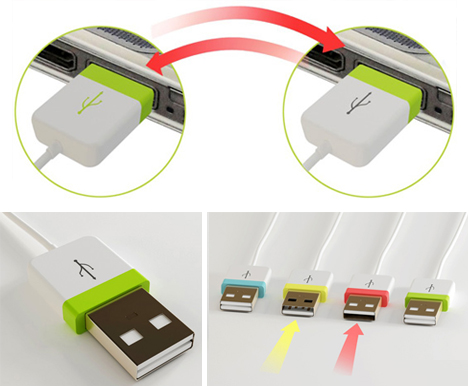
Sometimes something begs for a simple solution. The nearly-ubiquitous USB port is perhaps the technological poster child for an obvious failure to work both ways (right-side-up or upside-down) despite looking perfectly symmetrical on both sides. Thankfully, and finally, this has been tackled from two directions (appropriately enough): one more idealistic, one more realistic, but both ingenious.


Ma Yi Xuan is a student designer who has solved the problem in theory, and in reality by UltraTek‘s new Flipper. These answers have been a long time coming. This author, for example, has bend more than one USB plug (and port), though fortunately only destroyed one to date.


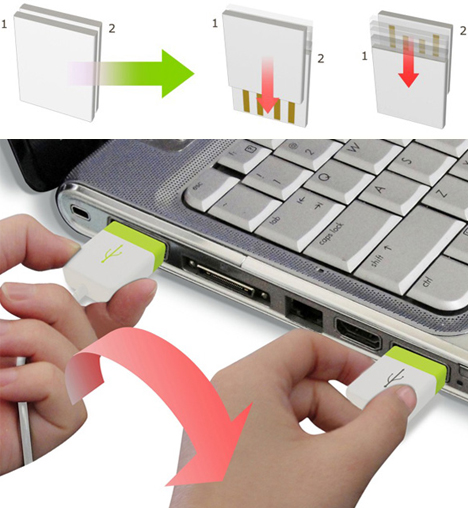
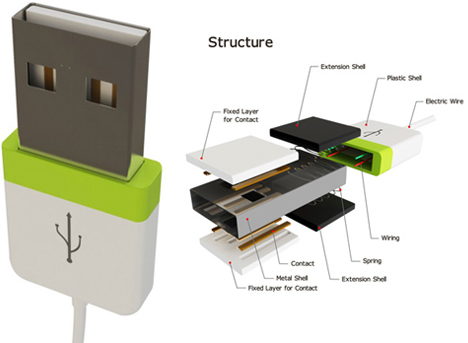
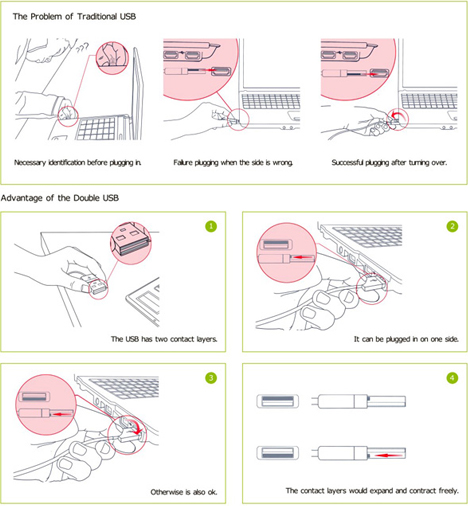
In the student version, there is a piece on either side of the interior that slides out of the way to reveal a data connection – which half moves depends on what way the plug is placed into the accepting slot. Simple, but vital for making this work both ways.


If you have not encountered the error of normal-style USB plugs, well, it is becoming a bigger issue the more we compute on a daily basis. In short: while there are sometimes visual indicators on the exterior housing of a plug-in, a forceful failure to insert the cord in the correct way can damage the socket permanently. Having a switchable solution could save many people from painfully expensive hardware fixes and replacements.


Source:
http://dornob.com

Saturday, December 31, 2011

Happy New Year 2012


Happy New Year Everybody

 I hope this year brings peace and happiness to everyone


Here are the Top 10 news of 2011.


1. Year of the Hacktivist 


2011 is undeniably the year of the hacktivist. Till 2010, hackers limited their attention and effort to hack for personal gain but year 2011 changed everthing.

As the hackers collectives such as LulzSec and Anonymous emerged, the motive behind hacking became more of a social crusade and less of personal gain. And in strokes after strokes, Web sites of major companies such as Sony Pictures, News Corporation and Petrobas, and government agencies such as FBI and CIA and even the U.S. Senate, which were once considered off-limits to hackers, fell.

The gaming industry was also not spared. PlayStation Network, Bethesda Game Studios and EVE Online were hacked impudently and taken down.And though, LulzSec quietened down in June/July (and probably disbanded), Anonymous refused to play dead and carried on to take on the might of nations such as Syria, Malaysia, Spain, Tunisia, Turkey, Brazil and Australia.


2. Social Media Stirs a Revolution


The power of social media to organize and influence the history was revealed to the fullest extent in year 2011. Sites such as Facebook and Twitter were no longer being used to just put up updates about one's life - they started to be used as tools for social change and influence the politics and the law of many nations. During 2011, the social media came to be used to mobilize grass root efforts all over the world, especially in Middle East and Africa such as Tunisia, Egypt, Libya and Syria to protest the status quo.


3. Steve Job's Death


Steve Jobs, a creative genius and a visionary who had established the most valuable company in the world, Apple, passed away at the age of 56, on Oct. 5. 

People around the world paid rich tributes to him, including Bill Gates, Mark Zuckerburg, Barack Obama and other celebrities and admirers. It was not surprising, as Jobs had radically changed the way people use technology in their daily lives.


4. Siri


When iPhone 4S was launched, critics said it had nothing spectacular to offer and Apple fans would be disappointed. However, Apple proved the critics wrong as iPhone 4S turned out to be the best selling iPhone ever - it even smashed previous debut weekend sales record. This was largely in part because of Siri and industry analysts later noted that Siri has become the most popular feature of the Apple iPhone 4S.


5. Ice Cream Sandwich


Ice Cream Sandwich, Google's newest operating system (Android 4.0) for phones, tablets, and more, was officially launched at the Galaxy Nexus and Ice Cream Sandwich release event on Oct. 19 2011.

Android 4.0 boasts of exciting features, including easy multitasking, customizable home screens, rich notifications, resizable widgets, and deep interactivity. Moreover, Ice Cream Sandwich also adds powerful new ways of communicating and sharing.


6. Year of the Apple: iOS 5, Mac OS X Lion and iCloud Launched

 
After a long wait, Apple's iOS 5, Mac OS X Lion and iCloud were unveiled at WWDC (worldwide Developers Conference) 2011 on June 6.

iOS 5, which is regarded as Apple's "major" and “incredible” release for developers and customers alike, has over 200 new features, including Improved Notifications System, News Stand, Improved Mobile Safari, Reminders, Camera, Mail, PC Free Function, iMessage and more.

Mac OS X Lion, Apple's desktop and server operating system for Macintosh computers, was a huge hit, notching a sales record of 1 million units on the first day of its release. It was the first time Apple sold Mac OS as a downloadable software. 

iCloud, Apple's cloud storage and cloud computing service which replaces MobileMe service, can help users to store data on remote computer servers for download to multiple devices including iOS-based devices, and personal computers running Mac OS X or Microsoft Windows. 


7. Nest Energy Efficient Thermostat


Nest Energy Efficient Thermostat, a sensing, automatic energy-saving thermostat developed by Tony Fadell, the creator of iPod, made waves in 2011. 

The thermostat is no ordinary, traditional mercury-filled home thermostat we're all used to. Unlike other thermostats, the user-friendly Nest will "learn" and keep track of when you turn its temperature up and down. It remembers those adjustments in line with the particular times of day and night when you change them. And, after about a week, Nest will start regulating the temperature on its own for you.


8. Acquisitions - Hits and Misses

This year, the acquisitions among tech companies made headlines for one reason or the other. Microsoft bought Skype in May for $8.5 billion, which is the software giant's largest acquisition ever. In August, the Internet search engine giant Google acquired Motorola Mobility, the maker of smartphones and set-top boxes, for $40.00 per share in cash, or a total of about $12.5 billion.


9. Amazon Kindle Fire

 
In 2011, for the first time, Apple's evergreen iPad met its match (or just about) in the form of Kindle Fire from e-retailer Amazon. When Amazon made headlines by launching a price-breaking tablet ($199) and though the company said Kindle Fire is not out there to challenge iPad, Apple's popular tablet faced real threat for the first time as Kindle Fire turned out to be Amazon's best selling product ever. 

For the first time, people woke up to the potential for e-reading and consumption of audio and video contents and the success of the 7-inch tablet has now emboldened other tablet makers to announce plans of launch of affordable tablets in 2012.


10. Apple Versus Samsung Courtroom Battles

The courtroom battles between Apple and Samsung around the world never seems to end. Early in April, Apple sued the Korean electronics giant in the U.S., claiming Samsung infringed its patent for list-scrolling software and three smartphone and tablet design patents. Subsequently, the patent war between the two companies expanded to Europe and Australia.


sources: http://www.ibtimes.com
               http://www.google.com